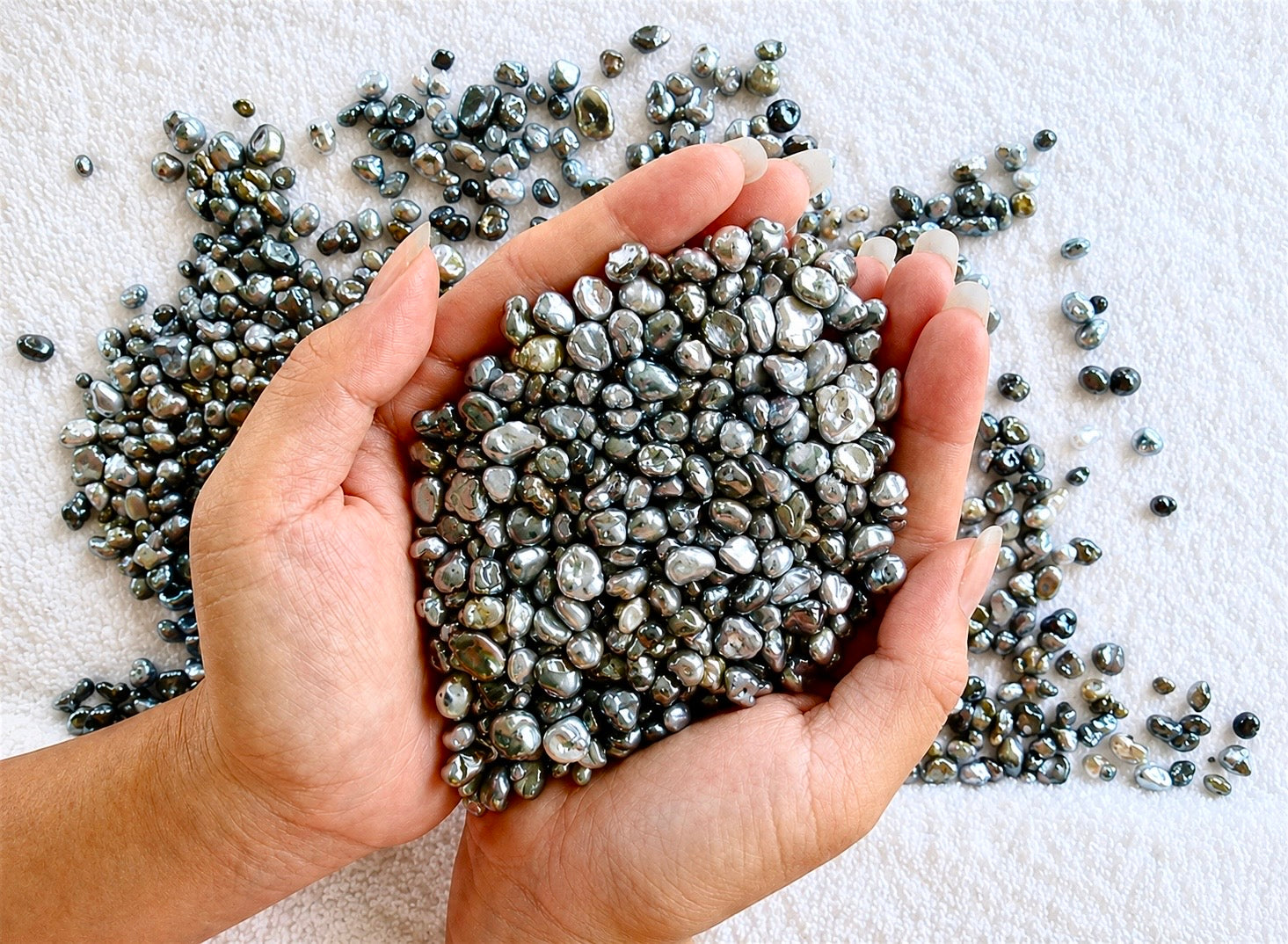
What Are Tahitian Keshi Pearls?
A keshi pearl is a non-beaded cultured pearl that forms as a by-product of the pearl-culturing process.
Unlike a traditional Tahitian cultured pearl, which develops around an implanted bead nucleus, a keshi has no bead nucleus. It can form when an oyster rejects the implanted nucleus while the pearl sac continues producing nacre, or when additional pearl sacs develop during the grafting process.
The result is a pearl composed essentially entirely of layers of nacre.
Naturally Unique
Tahitian keshi pearls display the beautiful natural colors associated with Tahitian cultured pearls—from silvery gray and deep charcoal to shades of green, blue, bronze and peacock.
Without a round nucleus to guide their growth, no two keshi develop exactly alike. Their wonderfully organic shapes can be baroque, oval, rice-shaped, flat or semi-round, while naturally round keshi are exceptionally rare.
Their irregular shapes are part of what makes them so special—each one is truly unique.
Small Pearls with Exceptional Luster
Keshi pearls are particularly prized for their brilliant luster and beautiful orient. Because they are formed without a bead nucleus, their beauty comes from layer upon layer of nacre.
At Te Hotu Mana Creations, we carefully select some of the finest Tahitian keshi we can find, choosing pearls for their exceptional luster, beautiful natural colors, strong orient and clean surfaces.
High-quality Tahitian keshi are increasingly difficult to source. Improvements in pearl-farming techniques have helped farmers reduce nucleus rejection and better manage the culturing process, meaning fewer keshi are produced as a by-product.
This combination of rarity, natural beauty and individuality makes fine Tahitian keshi especially sought after.
Each keshi is a tiny, perfectly imperfect treasure from the lagoons of French Polynesia.